

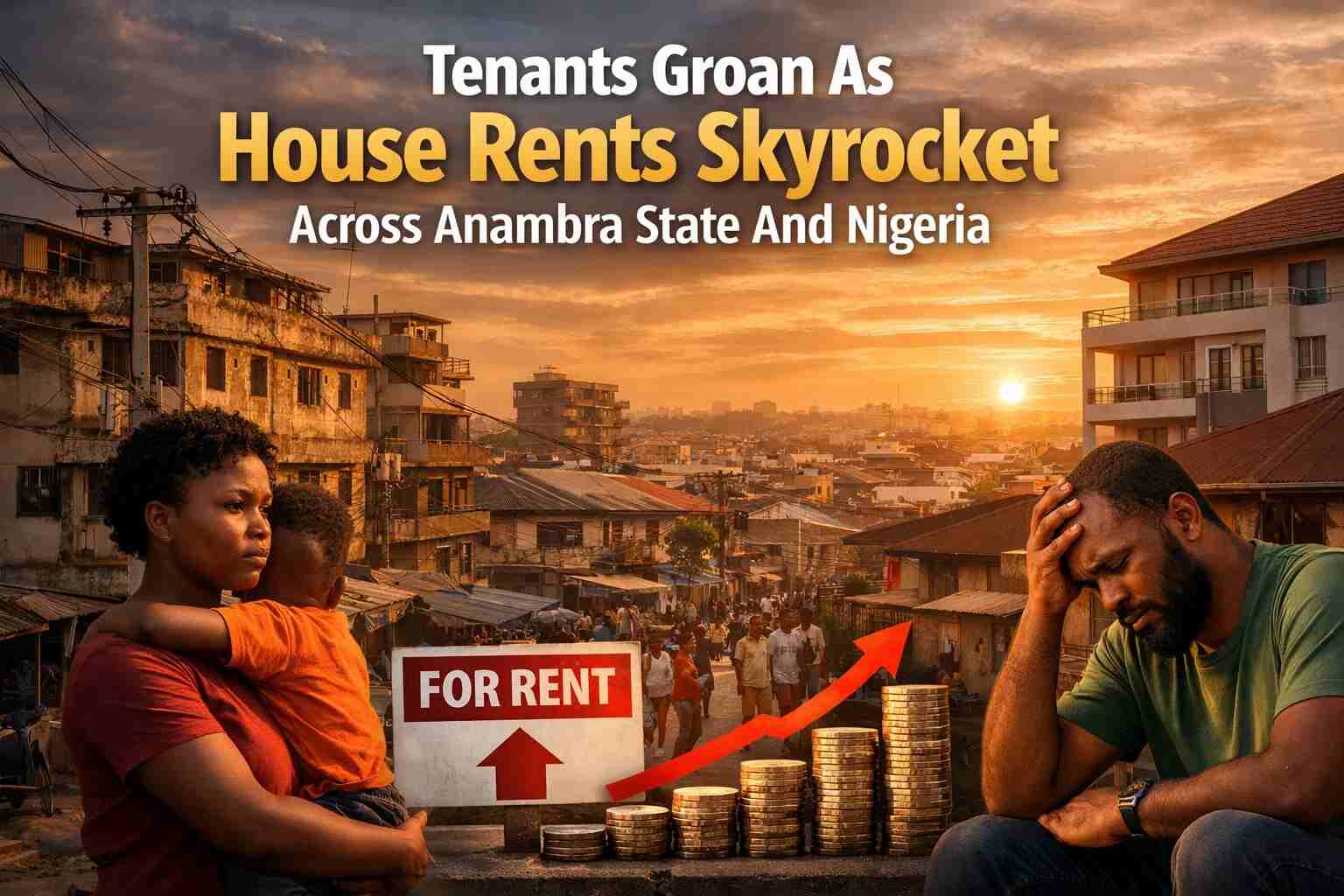
Tears, frustration and quiet displacement have become the daily reality of thousands of tenants not only in Anambra State but across the country, as house rents continue to rise at an alarming and unsustainable rate.
In Anambra state, what was once seen as a localized challenge in major commercial towns has now spread to Awka, Onitsha, Ekwulobia, Ihiala, Ogidi, Nkpor, Obosi, Agulu and several other communities, leaving low- and middle-income earners gasping for breath.
Across the State, findings reveal a troubling pattern of rapid and often indiscriminate rent increments. Residents speak in hushed tones about alleged closed-door understandings among some landlords and property agents, resulting in uniform and steep upward reviews that appear disconnected from prevailing economic realities.
In Nnewi, a three-bedroom flat with basic facilities that rented for about one hundred and twenty thousand naira per annum five years ago now goes for between eight hundred naira and nine hundred thousand naira. A two-bedroom apartment that previously cost sixty thousand naira to seventy thousand naira now attracts between six hundred thousand naira and seven hundred thousand naira annually.
In Awka, the State capital, modest self-contained apartments now go for between three hundred and fifty thousand naira and five hundred thousand naira per annum in areas that were previously considered affordable.
Two-bedroom flats in some parts of Onitsha, Nkpor and Obosi now command seven hundred thousand naira to over one million naira annually, depending on location. Even in semi-urban communities such as Nnobi, Oba, Ozubulu, Awka-Etiti and Agulu, rents have doubled or tripled within a short period.
These increases represent an exponential surge that has far outpaced wage growth, business profits and the general living conditions of ordinary citizens. The minimum wage and average earnings of civil servants, artisans, traders and factory workers simply cannot sustain the new rental regime.
What is more worrisome is that the trend cuts across both new and old buildings. Many landlords of aging structures have joined the upward review despite the absence of renovations or improvements that could justify such steep increments.
Many tenants now face displacement, relocating to distant communities or even neighbouring states where accommodation is relatively affordable. Commuting from long distances increases transportation costs, reduces productivity and strains family life.
Young couples and newly employed graduates are among the worst hit. What should be the foundation years of stability have turned into seasons of uncertainty. Some families are forced to downsize abruptly from three-bedroom apartments to one-room self-contains.
Others have had to move their children to less expensive schools due to rising transportation and living costs.
The ripple effects are already visible. Businesses struggle to retain staff who can no longer afford to live close to their workplaces. Informal settlements are gradually expanding as people search for cheaper shelter.
There is no doubt that the cost of building materials, land acquisition, taxes, and maintenance has risen significantly in recent years, but investment in residential and commercial buildings is a long-term venture and should not be treated like short-term trading aimed at instant windfall profits.
Government cannot remain silent while a critical sector of social welfare spirals beyond the reach of the average citizen.
A comprehensive housing policy review, strengthened rent control regulations, improved access to affordable housing schemes and incentives for developers who provide low-cost housing should be considered.
The time to act is now. A proactive, compassionate and well-regulated housing framework will not only protect tenants but also ensure long-term stability, productivity and inclusive growth across Anambra State and Nigeria.
DAVID ONWUCHEKWA


